Computo

© DC Comics / Used without permission
Origin: Transformed
Real Name: Danielle Foccart
First Appearance: Legion of Super Heroes Annual # 1 [DC Comics August 1982]
                            Character created by
Keith Giffen and Paul Levitz

ABILITIES


Prowess 4 {Fair}
Coordination 5 {Good}
Strength 4 {Fair}
Intellect 5 {Good}
Awareness 5 {Good}
Willpower 5 {Good}

Stamina: 9
Determination: 2

SPECIALTIES


Athletics
Leadership
Martial Arts
Technology (Computers)

POWERS


Interface 8
       Broadcast
       Haywire
       Multiple Machines

EQUIPMENT


QUALITIES

. Stubborn and self-reliant.
. Relationship: Jacques Foccart (brother)
. Inquisitive. 

Points: 64


ORIGIN STORY

Danielle Foccart was not a villain in human form. Her origin begins as as a child born and raised in the French West African nation of Côte d’Ivoire. Danielle suffered from a chronic neurological disorder which was confusing to a myriad of medical experts. Her brother Jacques Foccart also known as the Invisible Kid, brought her to Brainiac 5 of the Legion of Super-Heroes for observation and to find a cure to her illness. Brainiac 5 with haste and without proper research, used a piece of circuitry from the dismantled machine Computo, a highly advanced supercomputer he had created years earlier. The machine took over Danielle and she became possessed by the mechanical super-villain Computo. Danielle had been forever affected at the very biological core of her being, Computo’s interface added nanotechnology to her DNA.

Danielle had matured from a young girl controlled by Computo to a strong woman with super powers. Her technopathic powers and her brother’s affiliation with the Legion of Super-Heroes allowed Danielle to gain entry into the newly formed Legion. She rose up the ranks as Deputy Leader and was a trained hand-to-hand combatant.

Converted characters, most of the times, unavoidably exceeds the 45-point limitation that the ICONS Superpowered Roleplaying Game core book recommends. Character revised according to rules presented in ICONS Great Power book. Streamlined, once again, according to ICONS Superpowered Roleplaying: The Assembled Edition.
Read more

Nightwind

Origin: Birthright
Real Name: Berta Skye Haris
First Appearance: Legion of Super-Heroes Vol 2 #272 (February, 1981)
                            Character created by Robert Harris

ABILITIES


Prowess 5 {Good}
Coordination 5 {Good}
Strength 3 {Average}
Intellect 4 {Fair}
Awareness 3 {Average}
Willpower 4 {Fair}

Stamina: 7
Determination: 1

SPECIALTIES


Aerial Combat
Martial Arts

POWERS


Air Control 7 {Incredible}
       Blast
       Burst
       Flight
Super-Sense 2 {Weak}
       Additional Sense [Infravision]
       Additional Sense [Spatial Sense: air currents]

EQUIPMENT


QUALITIES

. Seriously committed to be a Legionnaire.
. Mature and pensive.
. Tries to project the image of a commanding and self-assured person.

Points: 56


ORIGIN STORY

Berta Skye Haris was born on Earth in the late 30th century and grew up longing for membership in the legendary Legion of Super-Heroes. Berta’s powers are the result of a genetic anomaly found in certain female descendants of her bloodline, anomalies that endow them with the ability to generate and manipulate wind currents. While possibly tied to the hormone cycle, the exact genetic cause of this power has not been established, nor has the exact method of genetic transfer. According to Berta, she was “given” her power by her grandmother when she was very young. There are rumors that Berta is actually from a small tribe on another planet where everyone has the power to control winds, but the truth is unclear.

In October 2983, she tried out for the Legion as Nightwind. She was rejected in favor of Blok. Her powers were considered worthwhile, but her cockiness and inexperience came through clearly during her try-out, when she assumed that an attack by the Starburst Bandits was simply a staged test. As a result, she did not treat the threat seriously and was knocked out without ever being a factor in the battle. Indeed, she was lucky to escape serious injury.

Upon the suggestion of Wildfire, whom she greatly admired, she enrolled in the Legion Academy, along with her fellow rejectees Lamprey and Crystal Kid. Although she desired the honor and recognition of Legion membership, she was very happy at the Academy, making good friends (Lamprey became her roommate), studying, and having opportunities to meet many of the Legionnaires. She treasured most her friendship with Wildfire, which she and Lamprey have kept up, becoming confidantes of sorts for him. This occasionally caused argument with other students like Comet Queen, who did not like his abrasive personality.

Some time after beginning her studies at the Legion Academy, Nightwind made a conscious effort to appear more mature and deserving of Legion membership, cultivating a somber, pensive manner and new, conservative costume in hopes of impressing the Legionnaires with her seriousness.

It's a pity the writers of Legion didn't take time to portray Nightwind in a deeper, clearer fashion. She seemed to be a nice character, with a nice set of powers and a different background (powers inherited only by females). Converted characters, most of the times, unavoidably exceeds the 45-point limitation that the ICONS Superpowered Roleplaying Game core book recommends. Character created according to rules presented in ICONS Great Power book and ICONS Superpowered Roleplaying: The Assembled Edition.
Read more

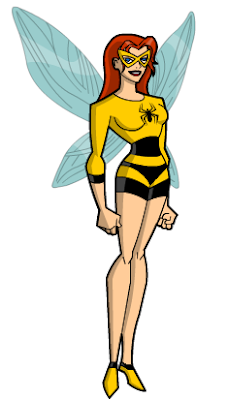
Insect Queen

Origin: Gimmick
Real Name: Lana Lang
First Appearance: Adventure Comics #355 [April 1967]
                            Character created by Otto Binder and Curt Swan

ABILITIES


Prowess 3 {Average}
Coordination 4 {Fair}
Strength 3 {Average}
Intellect 4 {Fair}
Awareness 4 {Fair}
Willpower 4 {Fair}

Stamina: 7
Determination: 5

SPECIALTIES


Investigation

POWERS


Transformation Device ["Bio Genetic Ring"] 8 {Amazing}
      Limits: One Type (Arthropods), Tell (human size and only the lower half of body).
     

EQUIPMENT


QUALITIES

. Can only use the same form once in 24 hours.
. New To This Superhero Stuff
. Spunky and bright, courageous reporter. 

Points: 31


ORIGIN STORY

Lana Lang was born and raised on a farm in the midwestern Kansas town of Smallville. During her teenage years, she met her next-door neighbor, Clark Kent, and developed an instant infatuation with him. Her interest in Clark was matched only by her affection towards the local super-hero, Superboy. Lana spent a large portion of her high school years obsessing over Superboy, and she labored intensively to discover his secret identity. One day Lana rescued an insect-like alien trapped by a fallen tree in Smallville. In gratitude, the alien gave her a "bio-genetic" ring which allowed Lana to gain insect (and insect-like, such as arachnids) characteristics.

After being given a Bio-Genetic ring by the aliens, Lana created a yellow honeybee-like costume and mask and adopted the codename Insect Queen who occasionally appeared as the crime-fighter. She had various adventures with Superboy and became an honorary member of the Legion of Super-Heroes.

Character revised according to rules presented in ICONS Great Power book. Streamlined, once again, according to ICONS Superpowered Roleplaying: The Assembled Edition.
Read more

Absorbancy Boy

© DC Comics / Used without permission
Origin: Birthright
Real Name: Kirt Niedrigh
First Appearance: Superboy and the Legion of Super-Heroes #218 [July 1976]
                            Character created by
Cary Bates and Mike Grell

ABILITIES


Prowess 4 {Fair}
Coordination 4 {Fair}
Strength 4 {Fair}
Intellect 5 {Good}
Awareness 4 {Fair}
Willpower 4 {Fair}

Stamina: 8
Determination: 3

SPECIALTIES


Athletics
History
Martial Arts
Politics

POWERS


Power Mimicry [Limits: close range, temporary, natural powers] 8 {Amazing}
       Residual Absorption
       Specialty Duplication

QUALITIES

. Motivation: Recognition.
. Reputation: xenophobic.
. Temper: especially when things don't go his way.

Points: 53


ORIGIN STORY

Kirt Niedrigh of Earth has the power to absorb any residual energy left behind by a super-powered being and then replicate that energy within himself. The origin of this power is unknown; presumably he is a mutant.

In about 2981, when about 17 years of age, Niedrigh applied for membership in the Legion of Super-Heroes as Absorbancy Boy. Because of the inherent limitations of his power, especially his dependence on the presence of other super-powered beings, he was rejected in favor of Tyroc.

Niedrigh was incensed by his rejection, feeling himself far more potentially powerful and useful than Tyroc, even though Tyroc was, himself, more formidable than the average Legionnaire. Absorbancy Boy may have had a point; it is doubtful that the Legion gave him opportunity to demonstrate the full extent of his powers, likely not having the patience to wait long enough for him to slowly duplicate the Legionnaires’ abilities. If they had, he might well have been accepted; after all, whatever his limitations, he had the power to equal or exceed Krypton-class. The dependence on the presence of other heroes might argue that the Legion was the perfect place for him; on his own, he would be able to do little, but with them, his contributions could be breathtaking. Teamwork is, after all, the secret of the Legion.

Sealed Legion archives, however, suggest that Niedrigh’s scores on the psychological tests given to Legion applicants gave cause for concern that, under stress, he might not behave with the sterling character required of Legionnaires. This, combined with the limitations of his power, was enough to cause the Legion to bypass Absorbancy Boy and give the nod to Tyroc.

Niedrigh quickly proved that concerns about his character were well-founded when he decided to break into Legion HQ, impersonate a villain, and seek revenge on Tyroc in battle. He did so by wearing a disguise that earlier had been used by both Sun Boy and Superboy, thus gaining both their powers. He easily defeated Superboy and challenged Tyroc to single combat. His inexperience with his borrowed super-hearing left him easy prey to Tyroc’s deafening ultrasonic scream, and he was defeated.

Outwardly, he gives a great impression of arrogance and confident superiority. Inwardly, he’s a mass of insecurity—the Legion’s rejection of him was only confirmation of his own doubts about the worth of his power and his character. He couldn’t handle it, and retreated from reality into a petty revenge fantasy to help him deal with the fact of rejection. He desires to grind down those who rejected him into submission, and would likely be devoted to anyone who showed him respect, making him easy prey to manipulation by other villains. It is rumoured that he was offered membership in the Legion of Super-Villains.

Although he was brought back semi-reformed under Geoff Johns's writing, Kirt was, created to be a villain, and I've decided to keep him this way. Converted characters, most of the times, unavoidably exceeds the 45-point limitation that the ICONS Superpowered Roleplaying Game core book recommends. Character revised according to rules presented in ICONS Great Power book. Streamlined, once again, according to ICONS Superpowered Roleplaying: The Assembled Edition.
Read more

Powers and Stunts: Omnibus!

The ICONS Great Power and ICONS Superpowered Roleplaying: The Assembled Edition books have almost everything you need to play well, in terms of powers. But the gamer in me loves to push the boundaries, chiefly when I'm trying to replicate what I've read in comics. This shifting space (come back often!) will  present the stunts that we don't usually see in the official books. 

Feel free to add yours, critique and evaluate.

Crystal Control


Control. You can create a crystal substance from nothing or rearrange the molecular bonds of normal substances into a crystal matrix of great strength. You can transform any material into a gemlike substance with hardness equal to their power intensity. Crystal can be formed in any shape you desire. You can create 1.50 meters square of crystal per power intensity in a single round. If this power is used on a living target, inherent safeguards leave that target in a state of suspended animation; all life functions temporarily cease, but the target remains aware of its condition and surroundings. A crystallized life form must remain intact if the process is to be reversed. If the crystallized life form is shattered, the transformation is permanent.

Extras

Crystal Shield: You create a shield that can block multiple attacks with a material strength equal to the power's intensity. Attacks that get through shatters the shield but don't damage you.

Crystal Slide: You hero skate on ramps of crystal that allow Flight 1 while in Extended distance of the ground. You cannot make quick turns or stops, but with supports can cause the ramp to rise. Crystal slides are permanent, unless the hero doesn’t want it.

Crystal Weapons: You can create a melee weapon of crystal  with a material strength equal up to +6 intensity and a damage bonus equal to its material strength.

Encasement: With a successful Crystal Control (Coordination) test, you can solidify a foe so that he or she cannot move. The target may make an average Strength test to break free; otherwise, he or she will have to wait till the crystal melts away.

Resistance to Light (Attacks): You gain Resistance to Light, only for its attacks, because you use crystal to scatter light and reduce intensity by the power’s intensity.

Sharp Shard Spray: You create sharp shards of crystal that you can shoot up to Extended distance. These missiles cause  damage equal to the power's intensity.

General Stunts

Blast: Seeking 

Your blast has limited independence from you. If your attack misses the target, it will circle around and try again on the succeeding panels, getting a test to hit on each of the attacker's panels until it either hits or the target finds some way to evade it altogether (such as causing it to hit something else).

Mind Shield: Façade

You can also project a false façade, so that any attempt to read or influence your mind perceives what you want the intruder to perceive.
Read more

Villainous Motivation

In ICONS Superpowered Roleplaying: The Assembled Edition (page 187), it's said that a villain's motivations help define their goals and plans and establish the villain in the game setting. For those Game Masters with problems devising motivations for their impromptu villains, here it is a list to help you out. As always, please feel free to discuss, critique and evaluate in the comments below.

VILLAINOUS MOTIVATION
Roll 2D6 or pick up the one(s) you deem appropriate.

2 Insanity: This villain is insane. Roll again, twisting the result to make it very extreme and deeply irrational. (For example, if you re-roll and get "Carnage", then perhaps the villain wants to destroy the entire world).

3 Vengeance: Something was done to this villain that they think was unjustified. The villain wants to pay back the ones he thinks are responsible.

4 Dystopian: The villain's world-view drives them to establish an evil, oppressive government, religion, or other authoritarian institution.

5 Thrill-Seeker: The villain is mainly driven by the thrill of accomplishing daring crimes.

6 Greed: The villain is overwhelmed by desire for wealth. Even when great wealth is achieved, more must be gained.

7 Anarchist: The villain enjoys inflicting harm on authoritarian institutions.

8 Prejudice: This villain hates and despises some racial or ethnic group, wishing to undo their accomplishments and subjugate them to his/her will.

9 For Hire: The villain has no particular motivation of his or her own. But they've got a reputation for being good at crime, leading other criminals to employ them.

10 Egotist: The villain suffers from the delusion that she has a grand destiny, and deserving of wealth and power.

11 Publicity Seeker: The villain loves to be talked about, to have his picture in the paper, to collect newspaper clippings and watch TV coverage of his own crimes.

12 Carnage: The villain loves to destroy things, preferably ancient, famous, or venerated things.
Read more

Validus

© DC Comics / Used without permission
Origin: Transformed
Real Name: Garridan Ranzz
First Appearance: Adventure Comics #352 (January, 1967)
                            Character created by
Jim Shooter & Mort Weisinger

ABILITIES


Prowess 5 {Good}
Coordination 3 {Average}
Strength 9 {Fantastic}
Intellect 1 {Weak}
Awareness 3 {Average}
Willpower 3 {Average}

Stamina: 12
Determination: * - Villain

SPECIALTIES


None

POWERS


Blast ["Mental Lightning] 8 {Amazing}
Damage Resistance 9 {Fantastic}
Growth [Limit: Constant] 3
Mental Resistance 10 {Supreme}

QUALITIES


. Mindless.
. Filled with undirected rage and given to rampages of destructions when provoked.
. "Smash It". 

Points: 54


ORIGIN STORY

The monster known as Validus is one of the dangerous oddities of the galaxy. His origins are unknown to the general public, but his destructive power, whether brute strength or the “mental lightning” he projects from his brain, are infamous. Efforts were underway to find a means of destroying the captured creature when the Legion recruited him against the Sun-Eater. Since then, Tharok has exerted influence over Validus, using the monster as his strong-arm and enforcer to control the Fatal Five.

In truth, Validus is the son of Garth Ranzz (Lightning Lad) and Imra Ardeen (Saturn Girl), taken from the future by Darkseid at the moment of his birth, and transformed into a monster. Sent backwards in time, Validus menaces his own parents. Eventually released from Darkseid’s “curse,” his true future remains to be seen.

Validus's Growth is a permanent part of his Strength and Damage Resistance levels; without it there are “merely” Incredible. Converted characters, most of the times, unavoidably exceeds the 45-point limitation that the ICONS Superpowered Roleplaying Game core book recommends. Character revised according to rules presented in ICONS Great Power book. Streamlined, once again, according to ICONS Superpowered Roleplaying: The Assembled Edition.
Read more

Mano

© DC Comics / Used without permission
Origin: Birthright
Real Name: Mano
First Appearance: Adventure Comics # 352 [DC Comics January 1967]
                            Character created by 
Jim Shooter and Curt Swan

ABILITIES


Prowess 5 {Good}
Coordination 5 {Good}
Strength 4 {Fair}
Intellect 3 {Average}
Awareness 4 {Fair}
Willpower 4 {Fair}

Stamina: 8
Determination: * - Villain

SPECIALTIES


Athletics
Martial Arts
Technology

POWERS


Corrosion 10 {Supreme}
       Extended

EQUIPMENT


Containment Suit
       Damage Resistance 4 {Fair}
       Immunity to Corrosion 10 {Supreme}
       Life Support 4 {Fair}
             Breathing
             Eating
             Pathogens
             Toxins 
       

QUALITIES


. An outcast in the midst of outcasts.
. Breathes toxic atmosphere.
. Infamous contract killer. 

Points: 65


ORIGIN STORY

A mutant born of the toxic, polluted environment of his homeworld of Angtu, Mano possesses a deadly antimatter “disintegration disk” on his right palm. An outcast even amongst his own outcast people, Mano used his powers to destroy his world, becoming an infamous contract killer throughout the galaxy.

Mano breathes an atmosphere poisonous to oxygen breathers, and so must wear a specialized containment suit virtually all of the time. His suit’s special gloves serve to help contain the annihilating power of his hand unless he chooses to unleash it.

Converted characters, most of the times, unavoidably exceeds the 45-point limitation that the ICONS Superpowered Roleplaying Game core book recommends. Character revised according to rules presented in ICONS Great Power book. Streamlined, once again, according to ICONS Superpowered Roleplaying: The Assembled Edition.
Read more

Ferro Lad

© DC Comics / Used without permission
Origin: Birthright
Real Name: Andrew Nolan
First Appearance: Adventure Comics #346 [DC Comics July 1966]

ABILITIES


Prowess 4 {Fair}
Coordination 5 {Good}
Strength 8* {Amazing}
Intellect 3 {Average}
Awareness 4 {Fair}
Willpower 5 {Good}

Stamina: 13*
Determination: 1

Strength is 4 in his normal form.

SPECIALTIES


Art (Painting)
Technology 

POWERS

Alternate Form ["Sentient, flexible Iron" (Solid)] 8 {Amazing}
       Damage Resistance
       Instant
Life Support 9 {Fantastic}
       Breathing
       Cold
       Eating
       Heat
       Pathogens
       Pressure
       Sleeping
       Toxins
       Vacuum 

EQUIPMENT


Legion Flight Ring

QUALITIES


. Daredevil: Need to give meaning to his previously secluded life. 
. Strange appearance: always wears his helmet to hide his disfigurement.
. Can go for days without nourishment or rest, but has to follow such time with equal period of coma-like sleep. 

Points: 52


ORIGIN STORY

Andrew was born one of twin sons of Luiza Karamonte, the famous and beautiful holovid star. A freak of genetics caused her two sons, Andrew and Douglas, to be born hideously deformed; something that was a kiss of death to Luiza's career; the tabloids wanted beautiful celebrity babies, not hideous mutants. She reacted to this after consulting with her PR firm by playing the role of the martyred mother, suffering a "terrible tragedy" that she was determined to overcome. Her career saved, Luiza dumped both her sons with doctors and psychologists in hospitals and rarely saw them again, except for very occasional photo opportunities when it was convenient for her.

Both Andrew and Douglas spent considerable time in mental institutions. Their power, to be able to transform their body into solid iron, did not offset the revulsion that most people felt toward their hideous appearance. Douglas became largely certifiable by a relatively young age, but Andrew seemed more capable of handling the psychological trauma of his condition and reacted better to counseling. Eventually he managed to be integrated with other children while wearing a facemask, and at the age of 13 he was released from the institution; no longer requiring psychological treatment and untreatable physically. 

His mother had no idea what to do with him, though she certainly didn't want him around her, and seemed angry at the doctors for having released Andrew at all. Finally she put him in an apartment in Metropolis with a small stipend and orders that he not be seen in public. 

For reasons he never revealed, but that can be guessed at, Andrew ignored his mother's orders and went to try out for the Legion of Super-Heroes, just as the legionnaires were getting ready to confront the Khund warfleet headed for earth. In the Legion, he finally found a place where he belonged; the legion had its share of freaks, and no one seemed to care that Andrew wore a mask. What mattered here were his powers.

At first, Andrew was still very shy around his companions and particularly in public; but when he started to see that the public actually liked him now, when he gained his own fan club, it woke something up in Andrew. Overnight, he became a daredevil; the first to charge in, the first to want to kick ass. His real personality emerged from behind all of his fears of rejection and Andrew became truly heroic, albeit highly reckless.

Ferro Lad is one of those hints that the Legion, in spite of its goofiness, was a little more mature than many other books at the time. Where else could a team book actually have a character die in one of his missions? This was pretty much brand-new stuff for comics at the time (Marvel can’t even keep his dead people dead, by the way), and it was done just fine, showing Ferro Lad knocking out Superboy and flying a bomb into the heart of a Sun-Eater, sacrificing his life to save the entire universe. This gave the goofy-named kid in the terrible costume (I mean... "Fe" on the front? At least the Metal Men had cooler symbols to use) a lifelong credibility he would never have gained otherwise, and he became a Legion legend for it. He was brought back near the end of the first continuity as a "chronal duplicate” and  it was kind of neat to give people a further look at a guy who never really got a chance to be a mainstream hero. Character revised according to rules presented in ICONS Great Power book. Streamlined, once again, according to ICONS Superpowered Roleplaying: The Assembled Edition.
Read more

Elsewhere


First, there was the ideascape, full of things-to-come, but not coalesced into existence. Then came The One. Or rather, one of his Alter Egos, The Genie. The One, as anybody knows, has no control over its transformations. But the ultras it has become (The One is a genderless alien being) can be very powerful. The Genie was one of those. Granted the powers to fulfil three wishes to a pure-hearted person, The Genie was battling Ultiman when, in saving a crippled African-descendant girl, he listened to her plaintive request: "I wish we could live in a city where everyone could have any kind of skin, eye colour, hair colour... I wish we could live Elsewhere, where human beings could live regardless of what they look like... Wouldn't it be nice to live in a city like this, Mr. Genie? A place where we could have all the architectonics a human mind could conceive, in neighbourhoods full of different and interesting people..." What a Genie could do but to comply? On a whim, just seconds before his Alter Ego could vanish to the Void of Beings (where all The One's Alter Egos end), there it was: Elsewhere.

Overview


Elsewhere is a melting pot of the humanoid metaverse, where Egyptian-like pyramids rise beside a thick urban jungle of alien skyscrapers and elevated highways that mesh to form a three-dimensional concrete lattice, a mosaic of patches of realities which have been linked together in a seamless urban landscape. Sometimes, areas of this cityscape shift: neighborhoods change position and shift out of the mosaic to make room for new arrivals. The city defies linear thinking: in Elsewhere everything is relative, even reality itself. Navigating, depending on where you are, is tricky. Someone travelling through the city actually travels through a series of realities that are connected by interdimensional interfaces.

An interface is a phenomenon that allows a traveller to pass from one precinct  into another (precinct is a neighborhood that surround the centre of Elsewhere, the "Metroplex", in contrast to the exurbias, which are more distant conurbations). Interfaces range from simple, straightforward portals to imperceptible transition zones. Each interface in Elsewhere is unique in some way. Most inhabitants step through dozens of interfaces every day without a second thought. Travel through some interfaces, however, can be complex, involving passing through seemingly solid walls, or following the correct sequence of turns through a maze of alleyways. Some interfaces change their positions with respect to one another. This phenomenon is commonly referred to as "drift", and it makes for a lot of headaches and confusion. Some interfaces stand still, some drift at steady glacial rates, while others drift fast enough that travellers have to run to catch them.

More often than not, all interfaces in Elsewhere link realities that have something in common. For instance, an interface may join a contemporary version of Quartier Latin in Paris with an alternate version of the same area in another City of Lights or with a city that is fundamentally different but bears some strong resemblance to the bohemian quarters in capital of France. The similarity between the realities interfaced in Elsewhere manifests physically in the city's architecture. Inhabitants use these similarities to help them navigate the city. This method isn't foolproof, however; it's common for inhabitants to misinterpret the similarities between realities, take a wrong turn, and get lost.

Portals, Doorways and Labyrinths


While there's an infinite variety of interface types there are few general categories that most of them fall under: portals, doorways and labyrinths.

A portal is a general term for any interface that is blatantly obvious. There may be some visual clue that gives the interface away such as swirling fog or a glowing edge.

A doorway is an interface that connects two vastly different realities. The term doorway is also used to describe any interface that is manmade or "artificial," whether it was created via magic or high technology.

A labyrinth is a cluster of subtle, often tightly packed interfaces, frequently a maze of alleys and side streets. Most labyrinths are nearly devoid of street traffic, either because their environments were deserted to begin with or because people who find themselves within a labyrinth soon get lost and stumble randomly out into the rest of Elsewhere.

Outside and Inside


Entering Elsewhere from the "outside" city can be problematical. First the traveller must find an interface that leads into Elsewhere. This usually isn't a problem for travellers who have just left it and want to return, as the chances are good that the interface is still where they left it — although it isn't unusual for inhabitants to get stranded in realities that phase out of Elsewhere. Depending upon how much of a reality is in phase, as measured by the size and number of interfaces connecting it to Elsewhere, entering can be routine or extremely difficult (often Elsewhere interfaces are invisible to "outside” observers). When interfaces are large and easy to spot, finding them is as simple as scanning the horizon. When interfaces are small or unreliable it takes searching, investigation, Elsewhere knowhow, and a bit of luck to find them.

If a traveller wishes to exit Elsewhere, they must find an exit point into a reality which is not surrounded by interfaces back into Elsewhere. "Leaving" Elsewhere entails finding an exit that leads "out," as opposed to an exit that leads to yet another part of Elsewhere. This can be extremely difficult, or even impossible in some cases. Many residents have been trying to return to their home reality for months, to no avail.

The nature of realities in Elsewhere


The exact nature of the realities that compose Elsewhere is open to debate. Most inhabitants simply think of them as neighborhoods ("precincts"), and leave it at that. People of a philosophical bent continually wrack their brains over the significance of the relationships between realities within Elsewhere, but in practical terms Elsewhere behaves like a city with neighborhoods. The catch is that Elsewhere isn't a conventional chunk of real estate but a web of realities linked together by interfaces. Elsewhere is part city, part interdimensional junction, and it combines properties of both.
Each reality in phase with Elsewhere vary in proprieties and laws. Some are governed by strict physical laws, others by the supernatural, many are at balance between the two. A reality which is governed solely by physical laws may not operate under the same physical laws that any other reality does. The same goes true for realities that are supernaturally oriented. Fortunately for inhabitants, interfaces compensate for these differences in realities by 'translating' people to adapt them to the conditions of the realities they travel into. Unfortunately, translation often doesn't function on equipment, inhabitants can't rely on technological or magical equipment  being translated to operate properly in a new reality. There are realities where technology above a certain level of sophistication doesn't work, or where technology doesn't function at all. In a number of other realities in Elsewhere, magic doesn't exist and is incapable of functioning. Many precincts also have idiosyncratic properties: there are psionic precincts where everyone can communicate telepathically; 'ghost' realities where everyone is incorporeal; non-chromatic realities where colors don't exist and everything really is black-and-white, and so on.

The inhabitants


Elsewhere residents had to adapt in a variety of ways. Some were quickly able to make intuitive sense of the city's unique features, while other inhabitants only came to understand the city through months of head scratching and contemplation (some are still on the verge of lunacy, in trying to understand the scope of it all). Despite any misgivings they have about Elsewhere, most inhabitants wouldn't want to live anywhere else. They tend to perceive the city as the center of all that exists, and they can be snobbish towards inhabitants of mundane cities and outback realities.

There are all sorts of people in Elsewhere, but one thing unifies them: they are from [a] planet Earth, thousands of different versions of which that have come into phase with Elsewhere at one time or another. Realities containing humans or humanoid creatures predominate. There are areas of Elsewhere, however, where different kinds of realities and beings exist. These areas are extremely difficult to get to/from "conventional" Elsewhere. Although not technically "far" from the rest of Elsewhere (almost all of them located in the exurbias), these areas are isolated by the difficulty involved in getting to them. Travellers to "unconventional" areas may have to negotiate their way through a complex sequence of portals and labyrinths. As a general rule, the more isolated an area in Elsewhere is, the more alien it is from a humanoid perspective.

My setting. A patchwork from many books and series I've read and watched throughout the years, from Nexus to Cynosure, from Tanelorn to Top Ten, from Defiance to Babylon 5 (not forgetting my beloved Legion of Super-Heroes and Star Trek). It also gives leeway to have all sorts of interaction, not straying from the hominid type too much, but giving space to some alienness. A cosmpolitan space station in conurbation form, a world full of alien races in an area of several kilometres: that's how I envision Elsewhere. Some precincts are already fleshed out: the Metroplex (the center of Elsewhere); Township, Preserve, Bazaar, Province, Waterfront, Phantasmagoria and Necropolis; and the more distant exurbias of Singhabad, Hedjazi, Deraan, Escher-Bosch, Uhuru and Belcadiz. More are to come, depending on the characers created.

Read more

Andromeda

© DC Comics / Used without permission
Origin: Unearthly
Real Name: Laurel Gand
First Appearance: Legion of Super-Heroes (vol. 4) #5 (March, 1990)
                       Character created by
Tom & Mary Bierbaum, Keith Giffen and Al Gordon

ABILITIES


Prowess 5 {Good}
Coordination 5 {Good}
Strength 8 {Amazing}
Intellect 4 {Fair}
Awareness 5 {Good}
Willpower 5 {Good}

Stamina: 13
Determination: 1

SPECIALTIES


Martial Arts

POWERS

Blast ["Heat Vision"] 7 {Incredible}
Damage Resistance ["Invulnerability"] 9 {Fantastic}
Flight 8 {Amazing}
Life Support 4 {Fair}
       Breathing
       Cold
       Radiation
       Vacuum
Supersenses 7 {Incredible}
       Additional Sense ["Infravision"]
       Additional Sense ["Penetration Vision", Limit: Blocked (lead)]
       Additional Sense ["Ultrasonic Hearing"]
       Extended Hearing ["Ultra Hearing"] 2
       Extended Vision ["Ultra Vision"] 2

 QUALITIES

. Walking in her relative's footsteps.
. Solar-Powered (yellow sun grants her powers, red sun cancels them).
. Vulnerable to lead (mitigated by the constant usage of Brainiac 5's serum).

Points: 68


ORIGIN STORY


Laurel Gand is a Daxamite descendant of Del Gand, the older brother of the 21st century hero M'Onel. Laurel's parents worked and lived on Ricklef II, an asteroid in the outer rim of the Daxam system. Laurel lived with them and her mother, the station commander, insisted that Laurel know how to operate the station's weapons, training that would prove itself to be critical. Zaryan the Conqueror, one of the warlike Khunds, attacked the asteroid base. Everyone on the asteroid was killed, except for a hidden Laurel. She was able to activate the defenses, utterly destroying the Khundian fleet and earning her both their fear and their enmity. Because of her actions she was declared an enemy of the Khundish empire, and a hero to her world of Daxam. After the Khunds attempted to kill her, she was given a secret identity and sent to Earth for her safety under a yellow sun, where the powers of her Daxamite heritage would activate and help protect her. She was given an anti-lead serum, and took the name Leala Linder and stayed in an orphanage until she was visited by three female members of the Legion of Super-Heroes: Saturn Girl, Phantom Girl and Triad, when she was invited to try out for the Legion.

Converted characters unavoidably exceeds the 45-point limitation that the ICONS Superpowered Roleplaying Game core book recommends. Character revised according to rules presented in ICONS Great Power book. Streamlined, once again, according to ICONS Superpowered Roleplaying: The Assembled Edition.
Read more

Miraclo


Another piece of realia which many of comic book readers wouldn't mind to have, Miraclo pills tend to appear here and there as Internet memes, to represent a plethora of chemical solutions from flu to laziness. With the advent of political correctedness, some authors had to turn the pill into something more discreet in comics, to avoid negative comparisons with other forms of chemical addiction

Powers


Alteration Device 7 {Incredible}
       Ability Boost [Extra: Boost Two - Coordination and Strength]
       Damage Resistance
     

Origin Story

A special form of Phosphorus temporarily bonds with the ATP in muscle cells. This creates "Adenosine Quad-Phosphate", the energy from which is released to grant the user various abilities (see above). The effect lasts for about an hour, and the waste toxins generated are usually eliminated from the bloodstream within twenty four hours. It was created by the chemist Rex Tyler.

After Rex Tyler found a passion for chemistry, he landed a job as a researcher for Bannerman Chemicals. Through accidents and discoveries, Rex came to create the "Miraculous Vitamin" that would grant a group of test mice abilities that far exceeded the norm. Using it on himself, Rex found his own capabilities to extended to near superhuman levels, but only for one hour at a time. Realising the potential of Miraclo, Rex decided to keep this discovery to himself.

Rex Tyler's son, Rick Tyler, took Miraclo to become the second Hourman. He became dangerously addicted to the chemical for a time and even contracted Leukemia from prolonged exposure to the drug. It was Matthew Tyler, an android from the future (that later becomes the third Hourman), that cured Rick of his disease and helped him control his use of Miraclo. Rick developed a way to use Miraclo in a non-pill form by pressing a button in his suit that secretes Micralo into his skin, still giving him powers for one hour.

A fun idea, although not politically (or healthily) correct, the Miraclo pills were modernly retconned to be a solution for muscular dystrophy, which would make it much more valuable. In a medium full of chemical enhancements (Venom, anyone?), Miraclo tended to be useful only for the Tylers, though.
Read more

Star Boy

© DC Comics / Used without permission
Origin: Birthright
Real Name: Thom Kallor
First Appearance: Adventure Comics # 282 [DC Comics March 1961]
                            Character created by
Otto Binder and George Papp

ABILITIES


Prowess 4 {Fair}
Coordination 4 {Fair}
Strength 4 {Fair}
Intellect 3 {Average}
Awareness 3 {Average}
Willpower 4 {Fair}

Stamina: 8
Determination: 6 / 5*

SPECIALTIES


Pilot

POWERS


Gravity Control [Limit: Increase Only] 9 {Fantastic}
       Strength Boost [Limit: Lifting Only] 
       OR
*Alteration Ray ["Density", (Limit: Offensive Only)] 9 {Fantastic}
       Offensive

EQUIPMENT


QUALITIES


. Adventurous Spirit.
. Really believes in the Legion way.
. Relationship: Dream Girl. 

Points: 41


ORIGIN STORY

Thom Kallor was born in the thirtieth century aboard an observation satellite orbiting the planet Xanthu, to parents who studied the stars by gathering their radiation - radiation that caused Kallor to be born a mutant with the ability to draw matter from the stars and add it to any object around him. Kallor’s abilities made him a scientific curiosity, studied by the scientists of Xanthu for years before he ran away to Earth, where he joined the Legion of Super-Heroes as Star Boy.

While in the Legion, Kallor fell in love with fellow Legionnaire Dream Girl. Soon thereafter, Kallor was attacked by a former suitor of Dream Girl wearing a shield that reflected Kallor’s powers back on himself. Immobilized and in mortal danger, Kallor was forced to kill the man. Though he acted in self-defense, Kallor was ejected from the Legion of Super-Heroes. After spending time redeeming himself as a member of the Legion of Substitute Heroes, Kallor was welcomed back into the Legion of Super-Heroes.

Star Boy is considered one of the most powerful beings in the galaxy, according to Brainiac 5, as he could create a black hole by using a simple object as a central point, though the black hole is apparently dependent upon his powers to remain active.

Star Boy's power sets are, according to a discussion with +Steve Kenson, quite interchangeable. The effects of both power sets are "basically the same". Because of the convoluted story of oh-so-many Star Boys, I've decided to stick with the essential, the one whose background story was the same for all versions. Also, I've discarded all the schizophreniac side of him, because of the abstruse way writers dealt with it. Character revised according to rules presented in ICONS Great Power book. Streamlined, once again, according to ICONS Superpowered Roleplaying: The Assembled Edition.
Read more

Princess Projectra

© DC Comics / Used without permission
Origin: Birthright
Real Name: Projectra "Jeckie" Wind’zzal
First Appearance: Adventure Comics #346 [DC Comics July 1966]
                            Character created by 
Jim Shooter

ABILITIES


Prowess 3 {Average}
Coordination 4 {Fair}
Strength 3 {Average}
Intellect 4 {Fair}
Awareness 6 {Amazing}
Willpower 6 {Great}

Stamina: 9
Determination: 1

SPECIALTIES


Martial Arts
Mental Resistance Expert
Occult Expert

POWERS


Extrasensory Perception 9 {Fantastic}
Illusion 9 {Fantastic}
Supersenses 8 {Amazing}
       Additional Sense ["Microscopic Vision"]
       Additional Sense ["Penetration Vision"]      
       Additional Sense ["True Sight"]
       Enhanced Hearing ["Accurate Hearing"]
       Enhanced Vision ["True Sight"] 4 {Fair}

EQUIPMENT


QUALITIES


. Queen of Orando.
. Responsibility: penance for taking Nemesis Kid's life.
. Relationship: Karate Kid. 

Points: 57


ORIGIN STORY

Princess Jeka Wind’zzal was the heir to the throne of Orando, a low-technology member world of the United Planets. She possesses the ability to generate illusions that can affect all five senses. After becoming a member of the Legion of Super-Heroes, she fell in love with and eventually married Karate Kid. Upon the death of the reigning monarch of Orando, Projectra and Karate Kid retired from active Legion of Super-Heroes membership and returned to Orando where Projectra took her place as queen. Shortly after she began her reign, the Legion of Super-Villains invaded Orando in an effort to use the planet as a vehicle into another universe. Karate Kid died to save the planet, and Queen Projectra, ignoring Legion by-laws that forbade killing, took Nemesis Kid’s life in retaliation. Resigning from the Legion at her husband’s funeral, Projectra used the warp device built by the Legion of Super-Villians to transfer Orando to another dimension, away from further “pollution” of the 31st century’s technology and dangers.

Projectra’s time with the Legion did not end there. The elders of Orando deemed that she should perform a penance for killing Nemesis Kid. Given further powers to see beyond the illusions of reality, Projectra was sent back to the main universe where she rejoined the Legion of Super-Heroes. At first she kept her identity secret even from her fellow Legionnaires, but her true identity was eventually revealed to the Legion when she was unmasked by the Emerald Empress of the Fatal Five. 

Projectra has a large number of sensory powers at her disposal, giving her the ability to discern illusions from reality, and even occasionally part the veils of time and death. Projectra uses her illusion powers subtly, to obscure or block opponents’ senses, project areas of darkness, or to startle and disorient her foes, She has complete control over the senses of others, including sight, smell, hearing, touch, taste, balance, pain, etc, allowing her to freely alter and manipulate them. She can enhance, reduce or remove them temporarily,  causing target to sense things that aren't there or prevent them from sensing things that are, cause/remove sensory ailments, etc.

Projectra's ability to see beyond the illusions of life — such as the "illusions" of distance and physical obstacles — is somewhat hard to convey in ICONS terms, even with the extra "True Sight". I had to resort to the expertise of Steve Kenson himself to help me out [Thanks, Steve!]. Converted characters, most of the times, unavoidably exceeds the 45-point limitation that the ICONS Superpowered Roleplaying Game core book recommends. Character revised according to rules presented in ICONS Great Power book. Streamlined, once again, according to ICONS Superpowered Roleplaying: The Assembled Edition.
Read more

Chameleon Boy

© DC Comics / Used without permission
Origin: Unearthly
Real Name: Reep Daggle
First Appearance: Action Comics # 267 [DC Comics August 1960]
                            Character created by
Jerry Siegel and Jim Mooney

ABILITIES


Prowess 4 {Fair}
Coordination 5 {Good}
Strength 4 {Fair}
Intellect 4 {Fair}
Awareness 5 {Good}
Willpower 7 {Incredible}

Stamina: 11
Determination: 1

SPECIALTIES


Deception
Investigation Expert
Performance Expert
Stealth Master

POWERS


Detection (Target’s molecular structure) 3 {Average}
Transformation: (Animals) 8 {Amazing}
       Extra Type: Humanoids
       Extra Type: Objects (Limit: Disguise)
       Growth
       Instant
       Shrinking
       Stretching

EQUIPMENT


QUALITIES

. Antennae: Binding his antennae keeps Reep from using his Detection powers.
. Vulnerability: Exposed to large amounts of high radiation freezes him in the shape he is in for one chapter.
. Prejudice: Durlans are viewed with suspicion throughout the galaxay.

Points: 93


ORIGIN STORY

Reep’s past is shrouded in mystery and confusion, but the undisputable truth is that he joined the Legion to better the image of all Durlans, using his people’s shapeshifting ability to become a spy and detective. His covert activities landed him in prison when he almost started a war. He was released thanks to his actions to stop a Daxamite controlled by Darkseid. His powers were suppressed during his incarceration, but they returned eventually, but just in time for the Legion to disband. He would later be the force behind the recreation of the team to reassume his role as the Legion’s light-hearted super-spy. He serves as the permanent head of the Espionage Squad, due to his powers and his high detective skills.

Reep is altruistic and loyal, but he tends to adapt his outward behavior to his immediate environment, blending what others expect of him and what they project of themselves on him. He is, however, the proud owner of a grand sense of fun.

Reep is a shapechanger, like everyone from his planet, and his antennae can read a target’s molecular structure for later reproduction. While he can copy basic functions, appearance and physiology as well as changing his own size and chemical composition to a certain extent, he can’t reproduce an individual’s special powers, or the unique and complex abilities from other creatures. Chameleon is also the son of R.J. Brande, an intergalactic entrepreneur, who is locked in human form and hid their relationship for years.

Converted characters, most of the times, unavoidably exceeds the 45-point limitation that the ICONS Superpowered Roleplaying Game core book recommends. With the revision, according to to rules presented in ICONS Great Power book, Chameleon got immensely more expensive, bringing to light the powerhouse he is. Streamlined, once again, according to ICONS Superpowered Roleplaying: The Assembled Edition.
Read more
(c) Fabrício César Franco 2015. Powered by Blogger.